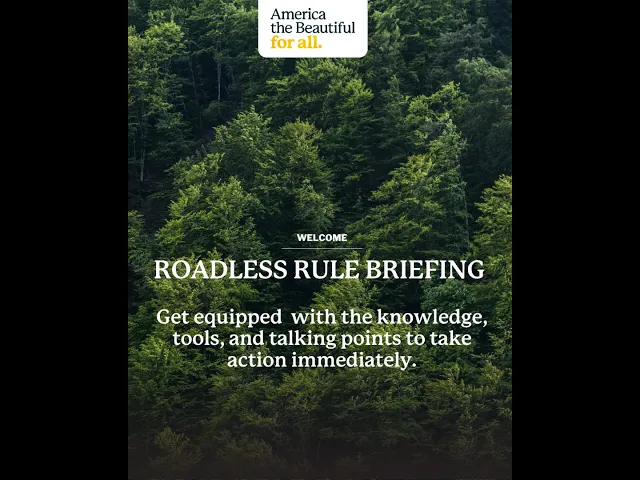
Our Roadless Forests are places in our national forests with no roads. No clearcuts. No signs telling you where they start or end. Just standing forest, doing what it has always done: catching rain and cleaning it, providing drinking water, holding soil in place, sheltering salmon and grizzlies and Puerto Rican parrots, cooling the air, and giving people somewhere to hunt, fish, walk, gather, and breathe. One rule has protected these places for a generation.
Our Roadless Forests are places in our national forests with no roads. No clearcuts. No signs telling you where they start or end. Just standing forest, doing what it has always done: catching rain and cleaning it, providing drinking water, holding soil in place, sheltering salmon and grizzlies and Puerto Rican parrots, cooling the air, and giving people somewhere to hunt, fish, walk, gather, and breathe. One rule has protected these places for a generation.
Our Roadless Forests are places in our national forests with no roads. No clearcuts. No signs telling you where they start or end. Just standing forest, doing what it has always done: catching rain and cleaning it, providing drinking water, holding soil in place, sheltering salmon and grizzlies and Puerto Rican parrots, cooling the air, and giving people somewhere to hunt, fish, walk, gather, and breathe. One rule has protected these places for a generation.
What Is the Roadless Rule?
The Roadless Rule, created in 2001, protects about 45 million acres of undeveloped national forest lands in the U.S. from new road building and large-scale logging, preserving these areas as natural, road-free backcountry.
The Roadless Rule, created in 2001, protects about 45 million acres of undeveloped national forest lands in the U.S. from new road building and large-scale logging, preserving these areas as natural, road-free backcountry.
“The USDA is manufacturing controversy around a policy that, for decades, has enjoyed broad public support. The Roadless Rule is backed by supermajorities across the country because it protects healthy forests, clean water, wildlife habitat, and the watersheds millions of Americans depend on. The real threats to our national forests come from cuts to Forest Service staffing, the closure of offices across the country, and the loss of the capacity needed to manage our forests and reduce wildfire risk. Weakening the Roadless Rule puts forests and watersheds at risk, and could ultimately threaten access to safe, clean drinking water for Latino communities and communities across the country.”
— Mark Magaña, Founding President and CEO, GreenLatinos
We are defending the Roadless Rule because it sits exactly where we live: at the intersection of water, health, and justice.
Water. When roads and clearcuts carve up a watershed, sediment and pollution flow downstream into the taps of the communities least able to pay for treatment. Protecting roadless areas is source water protection.
Health. Clean water, clean air, and access to nature are the foundations of healthy communities. What happens to these forests happens to the people who depend on them.
Justice. The people who benefit from roadless areas are as diverse as America itself: rural and urban, Tribal nations, Latino communities, Black communities, and everyone downstream. Public lands belong to all, not to the highest bidder.
These forests take care of us. The Roadless Rule is how we take care of them.
The Roadless Rule, created in 2001, protects about 45 million acres of undeveloped national forest lands in the U.S. from new road building and large-scale logging, preserving these areas as natural, road-free backcountry.
We are defending the Roadless Rule because it sits exactly where we live: at the intersection of water, health, and justice.
Water. When roads and clearcuts carve up a watershed, sediment and pollution flow downstream into the taps of the communities least able to pay for treatment. Protecting roadless areas is source water protection.
Health. Clean water, clean air, and access to nature are the foundations of healthy communities. What happens to these forests happens to the people who depend on them.
Justice. The people who benefit from roadless areas are as diverse as America itself: rural and urban, Tribal nations, Latino communities, Black communities, and everyone downstream. Public lands belong to all, not to the highest bidder.
These forests take care of us. The Roadless Rule is how we take care of them.
We are defending the Roadless Rule because it sits exactly where we live: at the intersection of water, health, and justice.
Water. When roads and clearcuts carve up a watershed, sediment and pollution flow downstream into the taps of the communities least able to pay for treatment. Protecting roadless areas is source water protection.
Health. Clean water, clean air, and access to nature are the foundations of healthy communities. What happens to these forests happens to the people who depend on them.
Justice. The people who benefit from roadless areas are as diverse as America itself: rural and urban, Tribal nations, Latino communities, Black communities, and everyone downstream. Public lands belong to all, not to the highest bidder.
These forests take care of us. The Roadless Rule is how we take care of them.
Take Action Today
The Forest Service has released its Draft Environmental Impact Statement proposing a full rescission of the Roadless Rule and is taking public comments through October 6, 2026. Our coalition is urging the administration to extend the comment period, because 25 years of protection deserves more than 33 days of process.
Here is what you can do right now:
Sign our coalition comment letter. Organizations: add your name to the AtB4A sign-on comment letter and share it with your networks.
Submit a public comment by October 6. Speak from your own life: the water you drink, the forest you know, the community you love. Every comment adds to a legal record the administration must review. If you want more support in crafting your response, check out these handy tools: Public Land Action Network hub and Save Roadless.
Contact your Congressional leaders and ask them to support the Roadless Area Conservation Act. Congress can stop this assault on our roadless forests by passing this bill (H.R. 3930 in the House and S. 2042 in the Senate) - ask them to sign on as a co-sponsor!
Show up at a public hearing or town hall. Town halls are happening across the country. Showing up in person tells decision makers that these forests have people behind them.
The Forest Service has released its Draft Environmental Impact Statement proposing a full rescission of the Roadless Rule and is taking public comments through October 6, 2026. Our coalition is urging the administration to extend the comment period, because 25 years of protection deserves more than 33 days of process.
Here is what you can do right now:
Sign our coalition comment letter. Organizations: add your name to the AtB4A sign-on comment letter and share it with your networks.
Submit a public comment by October 6. Speak from your own life: the water you drink, the forest you know, the community you love. Every comment adds to a legal record the administration must review. If you want more support in crafting your response, check out these handy tools: Public Land Action Network hub and Save Roadless.
Contact your Congressional leaders and ask them to support the Roadless Area Conservation Act. Congress can stop this assault on our roadless forests by passing this bill (H.R. 3930 in the House and S. 2042 in the Senate) - ask them to sign on as a co-sponsor!
Show up at a public hearing or town hall. Town halls are happening across the country. Showing up in person tells decision makers that these forests have people behind them.
The Forest Service has released its Draft Environmental Impact Statement proposing a full rescission of the Roadless Rule and is taking public comments through October 6, 2026. Our coalition is urging the administration to extend the comment period, because 25 years of protection deserves more than 33 days of process.
Here is what you can do right now:
Sign our coalition comment letter. Organizations: add your name to the AtB4A sign-on comment letter and share it with your networks.
Submit a public comment by October 6. Speak from your own life: the water you drink, the forest you know, the community you love. Every comment adds to a legal record the administration must review. If you want more support in crafting your response, check out these handy tools: Public Land Action Network hub and Save Roadless.
Contact your Congressional leaders and ask them to support the Roadless Area Conservation Act. Congress can stop this assault on our roadless forests by passing this bill (H.R. 3930 in the House and S. 2042 in the Senate) - ask them to sign on as a co-sponsor!
Show up at a public hearing or town hall. Town halls are happening across the country. Showing up in person tells decision makers that these forests have people behind them.
“Americans cherish their public lands and deserve leaders who protect them now and for future generations. Gutting the Roadless Area Conservation Rule is simply not an option – too many communities, ecosystems, wildlife species and local economies depend on keeping these wild forests healthy and undisturbed. Opening our backcountry forests to more roads and development, and therefore more ignitions, is also not a wildfire solution, and never will be. The Administration needs to hear us loud and clear: our roadless forests are some of the most important ecosystems across this country and must be managed as such.”
— Josh Hicks, Director of Conservation Campaigns, The Wilderness Society.
What is at stake?
Experts from Earthjustice, the Save the Roadless Coalition, GreenLatinos, and local forest defenders break down what the rule protects, what losing it would mean, and how communities from Alaska to Puerto Rico are defending it.
What is at stake?
A Better 250 Years to Come
A Better 250 Years to Come
These forests were standing long before us, and with care they will stand long after. The question every generation answers is whether to pass them on whole or hand them to the industries that would consume them. Twenty-five years ago, Americans answered together and built the Roadless Rule. Our coalition exists to help this generation answer the same way.
Tell us what these forests mean to you. Through our America 250 campaign for a better 250 years to come, we are collecting personal statements about the places that make America beautiful for all. Your forest, your watershed, your trail.
Roadless Rule Tribal Hub, resources for Tribal governments and organizations engaging in the federal process, built with Tribal partners and The Wilderness Society.
“For the last 25 years, the Roadless Rule has protected America’s most pristine and ecologically intact forests. Now, in a clear giveaway to billionaire industry executives– and against the wishes of the millions of people who have voiced their support for these protections over the last three decades – Trump and his allies want to gut protections for more than 44 million acres of our national forests. The lands protected by the Roadless Rule provide important wildlife habitat and clean drinking water for millions of people, and are critical to fighting the climate crisis. We cannot allow the Trump administration to bulldoze our public lands, national forests, and bedrock environmental protections – all to pad the profits of their industry donors.”
— America Fitzpatrick, Conservation Program Director, League of Conservation Voters
Subscribe to Our Newsletter
Stay up to date on events and opportunities to advocate for and celebrate progress on closing the nature gap for communities and wildlife.
Join the Coalition
We welcome nonprofits, collaboratives, and conservation-minded businesses across a range of missions working toward a common vision where all communities equitably benefit from healthy waters, accessible and vibrant landscapes, and thriving wildlife populations.
Stay up to date on events and opportunities to advocate for and celebrate progress on closing the nature gap for communities and wildlife.
Join the Coalition
We welcome nonprofits, collaboratives, and conservation-minded businesses across a range of missions working toward a common vision where all communities equitably benefit from healthy waters, accessible and vibrant landscapes, and thriving wildlife populations.
Stay up to date on events and opportunities to advocate for and celebrate progress on closing the nature gap for communities and wildlife.
Join the Coalition
We welcome nonprofits, collaboratives, and conservation-minded businesses across a range of missions working toward a common vision where all communities equitably benefit from healthy waters, accessible and vibrant landscapes, and thriving wildlife populations.